How to trade meme coins without losing your deposit on hype
Want articles like this for your own video to promote it on YouTube and Google? Order them through the Telegram bot @sat_sit_bot. It writes articles around your video, embeds the video and publishes them on popular niche websites (no ads). Try it free: 50 articles on us.
· based on the channel Orangie Web3
Key takeaways
- Meme coins are pure sentiment assets: price is driven by attention, liquidity and holder behavior, not by cash flow or earnings.
- Start with one dedicated hot wallet funded only with money you can lose entirely — never link your main wallet to new tokens.
- Before buying, check liquidity depth, holder concentration, contract permissions and whether the token can be paused, minted or taxed.
- Position sizing beats picking: risking 1–3% of your trading stack per bet keeps a run of losses survivable.
- Have an exit plan before entry — a target, a stop and a rule for what happens if liquidity disappears.
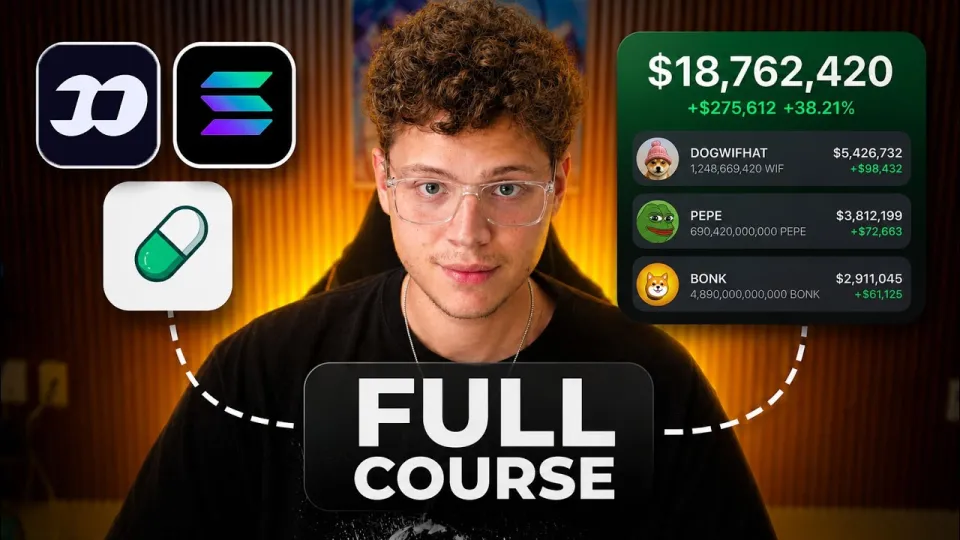
Meme coin trading is speculation on attention, not investing in a business, so the workable approach is to treat every position as a lottery ticket with a fixed price and a pre-written exit. You pick a token early, size the bet so a total loss is survivable, verify on-chain that the contract is not a trap, and sell into strength instead of hoping for a second leg. The beginner-friendly route into Solana meme coins shown in Orangie Web3's free course starts with a trading terminal — you can open one through the FOMO registration link — and the rest is discipline.
What a meme coin actually is and why the price moves
A meme coin is a token with no product, no revenue and usually no team roadmap; its price is set purely by supply, liquidity and the flow of new buyers. That single fact explains almost everything that happens to these tokens: a viral post brings buyers, buyers bring price, price brings more buyers, and the moment attention rotates elsewhere the same mechanism runs in reverse, often faster.
Key mechanics worth knowing before the first trade:
- Liquidity is the money sitting in the pool that lets you buy and sell. Thin liquidity means your own sell order can crash the price.
- Market cap vs. liquidity ratio tells you how fragile the chart is. A token with a large cap and tiny liquidity is a trap for anyone who wants out.
- Holder concentration matters more than follower counts. If a handful of wallets hold most of the supply, they decide when the party ends.
- Narrative speed is the whole game. Meme coins on Solana can go from launch to peak in hours, which is why pre-planned exits beat real-time decisions.
Treat the token as a story being priced in real time. Your job is not to decide whether the joke is funny, but whether the order book and holder list give you a realistic path back out.
How to set up a wallet and a trading terminal for meme coins
A clean setup is two wallets and one terminal: a hot wallet used only for meme coins, a separate main wallet that never touches unknown contracts, and a trading interface that shows you liquidity and holders before you click buy. Keeping these apart means a malicious token approval can only drain the small balance you deliberately exposed.
- Create a fresh hot wallet in a reputable browser or mobile wallet and write the seed phrase down offline. Never reuse a wallet that holds long-term assets.
- Fund it from an exchange with a small, fixed amount — the money you are fully prepared to lose. This is your trading stack, and it does not get topped up mid-loss.
- Connect to a terminal that surfaces liquidity, holder distribution and recent trades on the same screen as the buy button. The FOMO platform linked in the video description is the one the course walks through: https://fomo.family/r/orangie
- Set slippage deliberately. High slippage settings exist to push your order through thin pools — they also hand value to whoever is on the other side.
- Revoke approvals periodically from your wallet's settings so old contracts cannot keep spending permissions you granted months ago.
If you want to follow along with the community around the course, the Discord at https://discord.gg/memecoins and the author's Instagram at https://www.instagram.com/orangieyt/ are where the walkthroughs and follow-up questions live.
The pre-buy checklist that filters out most rug pulls
A rug pull is any exit scam where the people behind a token remove the liquidity or dump supply they secretly control, leaving everyone else holding something they cannot sell. Almost every rug leaves fingerprints on-chain before the price collapses, and a two-minute check catches the crude ones.
Run this list before every buy:
- Liquidity locked or burned? If the deployer can withdraw the pool at will, the token is a countdown timer.
- Can the contract mint more supply? A mintable token means your share can be diluted to nothing at any moment.
- Is there a pause, blacklist or trading-limit function? Any of these lets the team freeze your ability to sell.
- Who holds the supply? Look for clusters of fresh wallets funded from the same source — that is one person wearing many hats.
- How old is the pool and how many trades has it seen? A pool with a handful of buyers and a suspiciously smooth chart is usually manufactured volume.
- Does the social presence match the on-chain activity? Thousands of followers and forty holders is not a community, it is marketing.
None of this makes a token safe. It only removes the obvious traps so that the risk you take is market risk rather than counterparty fraud.
Position sizing and exit rules that keep you in the game
Risk management, not token selection, is what separates traders who last from traders who post screenshots once. Because most meme coins eventually go to zero, the only sustainable model is many small bets where a few winners pay for the losers.
A workable framework for a beginner:
- Cap each position at 1–3% of your trading stack. Ten straight losses at 2% costs you roughly 18% — annoying, not fatal. One position at 50% ends the game.
- Write the exit before the entry. Decide the market cap or percentage gain where you take initial capital out, and the level where you accept the loss.
- Scale out, don't fantasize. Selling half on the first strong move and letting the rest run converts a paper gain into a real one.
- Never average down into a falling meme coin. Adding to a loser assumes the crowd will come back, which is exactly the assumption the chart is disproving.
- Watch liquidity on the way up. If the pool is shrinking while the price rises, the exit door is narrowing.
A useful habit is to log every trade with entry, exit and the reason for each. After twenty entries the pattern in your own behavior — chasing, hesitating, oversizing — becomes obvious in a way no single chart can show.
Common questions beginners ask about meme coin trading
Most beginner confusion clusters around three things: where to buy, how much to risk, and how to tell a real opportunity from a manufactured one. None of these have perfect answers, but each has a defensible default.
- Where do I actually buy? Meme coins usually launch on decentralized exchanges, so you swap through a terminal rather than a centralized exchange listing. That means you are responsible for slippage, approvals and verifying the contract address yourself.
- How much can I make? Multiples happen, but they are rare and usually require being early and selling before the crowd. Counting on a 100x is a planning error, not a strategy.
- Why did my token die instantly? Usually because liquidity was thin, holders were concentrated, or the launch was designed to extract from buyers rather than build a community.
- Do I need to understand on-chain data? You need enough to read liquidity, holders and contract permissions. Deeper analysis — wallet clustering, deployer history, sniper behavior — is the natural next step once the basics are automatic.
A sensible progression is to trade tiny sizes for a few weeks while you learn how these markets behave, and only scale up after your process, not your luck, has produced results.
Useful links
- Trading terminal used in the course: https://fomo.family/r/orangie
- Community Discord: https://discord.gg/memecoins
- Author's Instagram: https://www.instagram.com/orangieyt/
Final thoughts
Meme coin trading rewards process over prediction: a separate hot wallet, a fixed risk per bet, a pre-buy contract check and an exit written down before entry will do more for your results than any single pick. The market is fast and mostly unforgiving, and the traders who survive are the ones who assumed from day one that most of their positions would fail. The beginner walkthrough from Orangie Web3 is a reasonable starting point precisely because it frames the whole thing as a discipline rather than a shortcut. If you want to follow the same path, start with the FOMO sign-up, keep your first positions small, and treat every loss as tuition rather than a reason to double down.
Source: Beginners Guide To Memecoin Trading in 2026 (FREE COURSE) · Markdown version
Questions & answers
How much money do I need to start trading meme coins?
You can start with a very small amount, and you should — the goal of the first weeks is learning the mechanics, not making money. Fund a dedicated hot wallet with an amount you would not miss if it went to zero, and keep each individual position to 1–3% of that stack. Scaling up only makes sense after your process has produced repeatable results.
What is a rug pull and how do I spot one before buying?
A rug pull is when the team behind a token drains its liquidity or dumps hidden supply, leaving buyers unable to sell. Before buying, check whether liquidity is locked or burned, whether the contract can mint new tokens, whether it has pause or blacklist functions, and how concentrated the holder list is. These checks filter out crude scams but do not make any token safe.
Can I trade meme coins without reading on-chain data?
You can place trades, but you cannot manage risk properly without at least the basics: liquidity depth, holder distribution and contract permissions. Those three checks take a couple of minutes and prevent the most common losses. Wallet clustering and deployer history are worth learning next, once the fundamentals are routine.
Why do most meme coins lose value so quickly?
Because their price depends entirely on new buyers arriving, with no revenue or product to anchor a valuation. When attention moves to the next token, the flow reverses and thin liquidity amplifies the drop. That is why pre-planned exits and small position sizes matter more than picking the right coin.